UNIQUE TOMATOES TOPS IN DISEASE-FIGHTING
ANTIOXIDANTS
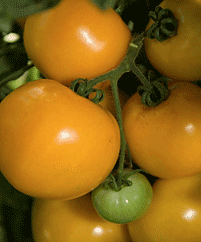 |
Tangerine
tomatoes |
“While red tomatoes contain far more lycopene than orange tomatoes,
most of it is in a form that the body doesn't absorb well,”
said Steven
Schwartz, the study's lead author and a professor of food
science and technology at Ohio State University.
“The people in the study actually consumed less lycopene when
they ate sauce made from the orange tomatoes, but they absorbed
far more lycopene than they would have if it had come from red
tomatoes,” he said. “That's what is so dramatic about it.”
The tomatoes used for this work were developed specifically
for the study – these particular varieties aren't readily available
in grocery stores. The researchers suggest that interested consumers
seek out orange- and gold-colored heirloom tomatoes as an alternative
to Tangerine tomatoes, but caution that they haven't tested
how much or what kind of lycopene these varieties contain.
Lycopene belongs to a family of antioxidants called the carotenoids,
which give certain fruits and vegetables their distinctive colors.
Carotenoids
are thought to have a number of health benefits, such as reducing
the risk of developing cancer, cardiovascular disease and macular
degeneration.
“The tomato is a wonderful biosynthetic factory for carotenoids,
and scientists are working on ways to enhance the fruit's antioxidant
content and composition,” Schwartz continued.
The
researchers don't know if tomatoes rich in cis- lycopene
would provide greater health benefits to humans, but the
study's results suggest that tomatoes can be used to increase
both the intake and absorption of the health-beneficial
compounds.
|
The findings appear in a recent issue of the Journal
of Agricultural and Food Chemistry.
Lycopene is a carotenoid that contains a variety of related
compounds called isomers. Isomers share the same chemical formula,
yet differ in chemical structure. In the case of tomatoes, the
different lycopene isomers play a part in determining the color
of the fruit.
Several years ago, Schwartz and his colleagues discovered the
abundance of several of these isomers, called cis- lycopenes,
in human blood. But most of the tomatoes and tomato-based products
we currently consume are rich in all-trans-lycopene.
“We don't know why our bodies seem to transform lycopene into
cis-isomers, or if some isomers are more beneficial
than others,” Schwartz said.
The researchers don't know if tomatoes rich in cis-lycopene
would provide greater health benefits to humans, but the study's
results suggest that tomatoes can be used to increase both the
intake and absorption of the health-beneficial compounds.
The researchers made spaghetti sauce from two tomato
varieties – tangerine tomatoes, which get their
name from their orange skin and are high in cis-lycopene,
and a tomato variety chosen for its rich beta carotene content.
The tomatoes were grown at an Ohio State-affiliated agricultural
research station in northwestern Ohio. Following harvest, both
tomato varieties were immediately processed into canned tomato
juice and concentrated. Italian seasoning was added for taste.
The 12 adults participating in the study ate two spaghetti
test meals – one included sauce made from tangerine tomatoes,
while the other featured sauce made from the tomatoes high in
beta carotene. The participants were asked to avoid tomato and
beta carotene-rich foods for 13 days before eating each test
meal.
Researchers drew blood right before each participant ate and
again every hour or two up to 10 hours after the meal. They
analyzed the blood samples for lycopene and beta carotene content.
Lycopene absorption from the tangerine tomatoes was 2.5 times
higher than that absorbed from the beta carotene-rich tomatoes
and, Schwartz said, from typical red tomato varieties. Cis-lycopene
levels spiked around five hours after eating the tangerine tomato
sauce, and at this point during absorption the levels were some
200 times greater than those of trans-lycopene, which
were nearly non-existent. While cis-lycopene is by
far the most abundant isomer in these tomatoes, they do contain
trace amounts of trans-lycopene.
The participants' bodies also readily absorbed beta carotene
from the beta carotene-rich tomatoes.
“Right now, only carrots and sweet potatoes are a more readily
available, richer source of beta carotene,” Schwartz said. “And
this carotenoid is a major source of vitamin A for a large proportion
of the world's population. Its deficiency is a serious health
problem in many developing countries.
“Our study showed that a tomato can also increase beta carotene
levels in the blood,” Schwartz said. While these special tomatoes
were grown just for this study, the researchers have pre-commercial
lines of both varieties available.
He conducted the study with Ohio State colleagues David
Francis, an associate professor of horticulture and crop
science; Steven
Clinton, an associate professor of hematology and oncology
and human nutrition; Nuray Unlu, a former postdoctoral researcher
in food science; and Torsten Bohn, a former postdoctoral fellow
in food science at Ohio State.
Funding for this work was provided by the Ohio
Agricultural and Development Research Center in Wooster;
the U.S.
Department of Agriculture's IFAFS program; the National
Center of Research Resources of the National Institutes of Health;
and the National Cancer Institute.
|